Men's Health Network

Men's Health NetworkMen's Health NetworkMen's Health Network

Men's Health Network

Men's Health NetworkMen's Health NetworkMen's Health Network
  • Home
  • Cancers
    • Bladder Cancer
    • Colorectal Cancer
    • Lung Cancer
    • Prostate Cancer
    • Testicular Cancer
  • Biomarker & Genetic Tests
  • Pillars of Resistance
  • About: MHN
  • More
    • Home
    • Cancers
      • Bladder Cancer
      • Colorectal Cancer
      • Lung Cancer
      • Prostate Cancer
      • Testicular Cancer
    • Biomarker & Genetic Tests
    • Pillars of Resistance
    • About: MHN
  • Home
  • Cancers
    • Bladder Cancer
    • Colorectal Cancer
    • Lung Cancer
    • Prostate Cancer
    • Testicular Cancer
  • Biomarker & Genetic Tests
  • Pillars of Resistance
  • About: MHN

Biomarkers & Genetic Testing

Understanding the Tests That Help Personalize Your Cancer Treatment

Cancer treatment is not a one-size-fits-all approach. Biomarker and genetic testing help your doctors understand what is happening inside your tumor so they can choose the treatments most likely to work for you.


This page explains what these tests are, why they matter, and the questions every man should ask.


What You Can Control

Control Cancer Evaluation & Treatment

You cannot change the DNA you were born with, but you can take control of how your cancer is evaluated and treated.


Biomarker testing and genetic testing are two different tools. Understanding the difference gives you more power in your treatment decisions.


Start by asking:

  • Have we done biomarker testing on my tumor?
  • What did the results show?
  • Will these results change my treatment options?
  • Are there more tests I need?

Genetic (Germline) Testing: What You Were Born With

This test looks at inherited mutations that are passed down by your parents. 


These mutations are present in every cell of your body and can:

  • Increase your lifelong cancer risk
  • Affect your family members
  • Help to guide your treatment plan

Examples: 

BRCA1, BRCA2, HOXB13


Sample types: 

Blood or saliva

Biomarkers vs. Genetic Testing: What Is the Difference?

Biomarkers: What Your Tumor Is Telling You

Biomarkers are changes inside the cancer cells. 


These changes help your care team understand:

  • How your tumor behaves
  • Which treatments are more likely to work
  • Whether your cancer may grow quickly or resist certain therapies
  • If you qualify for certain clinical trials

Examples:

  • A BRCA2 mutation inside the tumor may mean you could benefit from a PARP inhibitor.
  • An AR V7 biomarker may mean hormone therapy will not work.


Sample types: 

Tumor tissue, blood, or other fluids.

Why Biomarker Testing Matters

1. Get the right treatment

2. Avoid treatments that won't work

2. Avoid treatments that won't work

Precision medicine matches therapy to the exact biology of your cancer.

2. Avoid treatments that won't work

2. Avoid treatments that won't work

2. Avoid treatments that won't work

If your biomarkers show a treatment is unlikely to help, you can avoid unnecessary side effects.

3. Qualify for clinical trials

2. Avoid treatments that won't work

3. Qualify for clinical trials

Many trials require specific biomarkers.

4. See what might come next

5. Improve your chances of living

3. Qualify for clinical trials

Some biomarkers predict how aggressive your cancer is or how likely it is to return.

5. Improve your chances of living

5. Improve your chances of living

5. Improve your chances of living

Men who receive biomarker-guided treatment often have better outcomes.

* Patient Pro Tip

5. Improve your chances of living

5. Improve your chances of living

Many men never receive biomarker testing unless asked for. Always speak up.

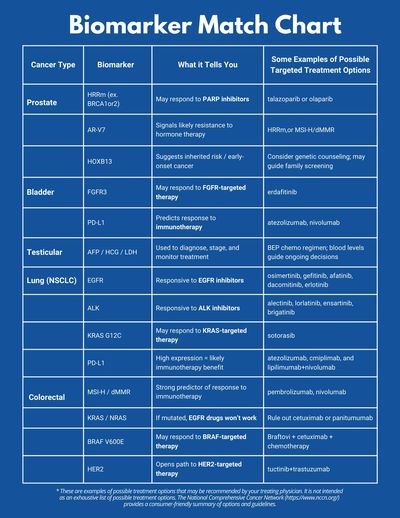
Biomarker Match Chart

Examples of what biomarkers can tell your care team:

Different cancers have different biomarkers. Each biomarker points to specific treatment options.


  • HRRm or BRCA mutations: May qualify you for PARP inhibitors
  • AR V7: Can show that hormone therapy will not work
  • FGFR3 (bladder cancer): May qualify you for FGFR targeted therapy
  • EGFR or ALK (lung cancer): May allow targeted drugs instead of chemo
  • MSI H or dMMR (colorectal cancer): Often respond well to immunotherapy
  • HER2 (rare in colorectal): Opens access to HER2 targeted treatment


* This information does not replace medical advice, but it shows how powerful biomarker results can be in shaping your plan.


* Right click on the image and select open in a new window or tab to see the full Biomarker Match Chart.
Questions to Ask Your Doctor

Bring these questions to your next appointment:

  • What type of cancer do I have?
  • Have we done biomarker and genetic testing?
  • Can you explain my test results?
  • Should we do more testing before choosing a treatment?


  • Will my biomarker results change the treatment you recommend?
  • Are targeted therapies or immunotherapies options for me?
  • How urgent is treatment? 
  • Do I have time for a second opinion?


If your provider seems unsure about biomarker testing, say:

  • “Can you refer me to someone who specializes in this”
  • “Should we get a second opinion from a cancer center that uses biomarker guided treatment”
  • “Can I speak with a nurse navigator or genetics counselor”


You are not being difficult. You are making sure to get the best care possible.

You Deserve Clear Information & Personalized Cancer Plan

Biomarker and genetic testing give you the information needed to make confident decisions and avoid guesswork. 


Understanding your cancer at the molecular level can shape your entire treatment plan and can sometimes save your life.

My Cancer, My Plan

Download

Men's Health Network

Copyright © 2025 Men's Health Network - All Rights Reserved. 

With Support From Pfizer. 


Men’s Health Network does not sell or share personal data. Information provided is used only for organizational communications and mission-related purposes. 

Powered by

This website uses cookies.

We use cookies to analyze website traffic and optimize your website experience. By accepting our use of cookies, your data will be aggregated with all other user data.

DeclineAgree